By Inna Kowalsky, founder of Cosmetics China Agency.
In 2023, China’s haircare market was worth 63.6 billion RMB, and it is still the most under-marketed category in Chinese beauty (Euromonitor, cited in industry analysis, 2024). Skincare and makeup get the campaigns, the KOL budgets and the livestream slots. Hair gets the leftovers, even though scalp care alone grew 19.6% year on year in 2024 to pass 21 billion RMB (「2026年度中国头皮健康产业需求趋势白皮书」whitepaper, 2026). This article lays out what the category is worth today, who is actually winning share, and where a foreign haircare brand still has room to enter before the shelf fills up.
Key figures to remember:
- China’s haircare market: 63.6 billion RMB in 2023, projected to grow 3.45% a year over five years (Euromonitor, 2024 industry analysis).
- Online haircare sales reached close to 30 billion RMB in 2023, up 11% year on year, split between Tmall (17.57 billion RMB) and Douyin (over 12 billion RMB).
- Scalp care passed 21 billion RMB in 2024, up 19.6% year on year, the fastest-growing sub-category in hair (whitepaper on scalp health demand, 2026).
- By origin, American brands held 33.3% of the market in 2023, French brands 17.4%, and Chinese domestic brands 15.0% (Euromonitor, 2023).
- China’s broader personal care industry (个护) reached 342.9 billion RMB in 2024, up from 189.2 billion RMB in 2017, an 8.9% compound annual growth rate (智研咨询 Zhiyan Consulting, April 2025).
The questions beauty brands ask before entering haircare in China
Every founder or brand manager I talk to about hair asks a version of the same five questions. Here is where this article answers each one.
Is haircare already saturated, or is there still room?
The category is far less crowded than skincare. Domestic brands only hold 15% of the market by origin (Euromonitor, 2023), which leaves the door open, especially in scalp care and repair, where no single brand dominates the way a handful of names dominate serums.
Which segment should a new brand target first?
Scalp care and anti-hair-loss are growing two to three times faster than basic shampoo (Mintel, industry analysis, 2024). A brand with a scalp or repair angle has an easier entry than a brand launching a generic shampoo line, similar to what we have seen play out in men’s grooming in China, another under-marketed segment.
Tmall, Douyin or Xiaohongshu first?
Tmall still carries the largest share of online haircare sales at 17.57 billion RMB against Douyin’s 12 billion RMB plus (2023 figures), but Douyin is growing faster and Xiaohongshu is where the buying decision gets made before the purchase happens on either platform. See how we break this down for the wider beauty category in our Xiaohongshu guide for cosmetics brands and our Douyin e-commerce case study. Section six below breaks haircare down channel by channel.
How much does a serious entry cost?
Less than skincare, because haircare KOC seeding runs on lower-cost formats: demonstration videos, before-and-after scalp shots, salon partnerships. A realistic seeding budget for a first wave sits in the low tens of thousands of RMB, not the six-figure sums skincare launches often need.
How long before the first sales show up?
Brands that pair a Xiaohongshu seeding phase with a Douyin store launch typically see traction within two to three months, faster than skincare because the purchase decision for shampoo or a scalp serum is lower-risk for the Chinese consumer.
What changed in China’s haircare market this year
Three shifts define 2026 for this category.
Scalp care is now the growth engine, not shampoo
The scalp health segment passed 21 billion RMB in 2024, up 19.6% year on year, and industry forecasts put the total haircare market at 80 billion RMB by 2029, with scalp care named as the category expected to drive most of that growth (2026 whitepaper on scalp health demand). Ninety four percent of urban Chinese consumers said they consider scalp health as important as skincare in a Mintel study from January 2021. That figure is now more than eighteen months old and consumer attitudes have only hardened since, according to more recent scalp-care sales growth, but we flag its age rather than presenting it as current.
| Year | China haircare market (RMB) | Scalp care segment (RMB) | Source |
|---|---|---|---|
| 2020 | 48.7 billion | not isolated | Mintel, January 2021 |
| 2023 | 63.6 billion | not isolated | Euromonitor, 2024 industry analysis |
| 2024 | estimated above 65 billion | 21 billion, +19.6% YoY | Scalp health demand whitepaper, 2026 |
| 2029 (forecast) | 80 billion | fastest-growing sub-category | Scalp health demand whitepaper, 2026 |
Douyin is closing the gap with Tmall
In 2023, Tmall still led online haircare sales at 17.57 billion RMB against Douyin’s more than 12 billion RMB (Euromonitor-based industry analysis, 2024). In the first quarter of 2026, Douyin’s shampoo sales alone exceeded 1.29 billion RMB, up 10.4% year on year, a channel that barely existed for haircare five years ago (财富号 Eastmoney, April 2026). Xiaohongshu does not carry the transaction volume of either platform, but it is where scalp and repair products get their credibility before the purchase happens elsewhere.
Domestic brands are catching up on ingredients, not yet on price power
Chinese brands such as 滋源 (Seeyoung) and 阿道夫 (Adolph) both rank in the top ten shampoo brands sold on Tmall in China in 2026 rankings (CNPP, 2026), built on silicone-free and botanical positioning that costs less to produce than the international premium tier. They still trail the American and French share of the market by 18 to 33 points respectively (Euromonitor, 2023), meaning premium and mid-premium pricing power remains with foreign names, for now.
What is holding the category back
Basic shampoo and generic conditioner are commoditized and price-competitive to the point of thin margins. A brand entering with an undifferentiated shampoo, no scalp or repair angle, and no ingredient story is entering the most contested and least profitable part of the category.
Benchmark: the haircare brands winning in China right now
Kérastase (L’Oréal), the premium proof point
Kérastase built the single strongest scalp-care market position of any brand tracked on Tmall, holding 16.37% share of the scalp-care sub-category between October 2020 and September 2021, the only brand at the time to clear 10% (Mintel and CBNData, cited in industry analysis, 2021). That data point is now dated, but Kérastase has kept its salon-grade positioning and its price has not moved down, which tells you premium credibility survives longer in hair than in skincare. What a smaller brand can copy: a narrow, clinical-sounding sub-line (scalp diagnosis, bond repair) rather than a full range at launch. What it cannot copy: the salon distribution network built over a decade, which took real capital and time.
Olaplex, the ingredient-story entry
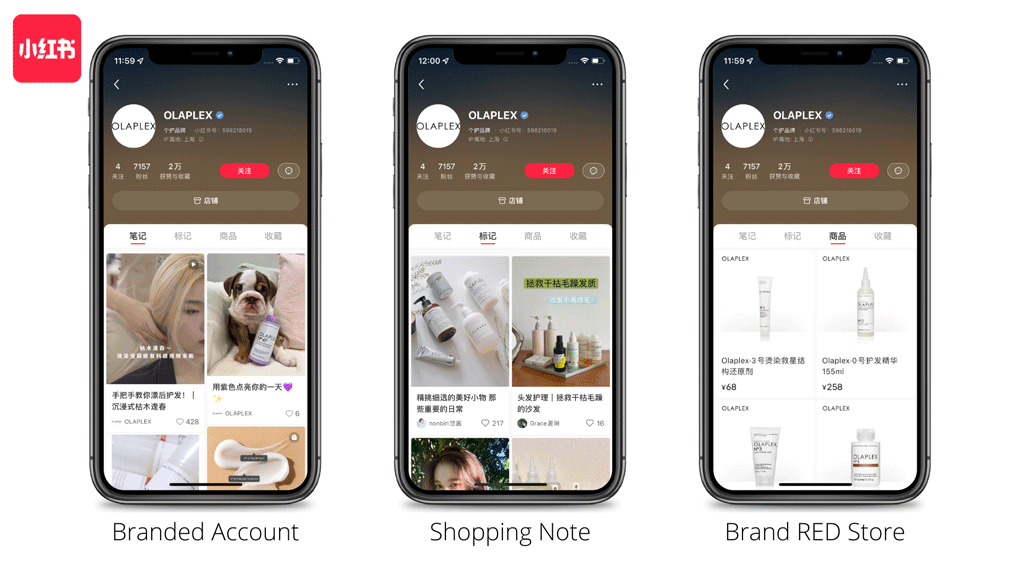
Olaplex entered China in August 2019 through Tmall and Xiaohongshu and now runs flagship stores across Tmall, Douyin, JD.com and Xiaohongshu. Its Xiaohongshu presence is built almost entirely on user-generated before-and-after content around bleached and damaged hair repair, not brand-produced advertising.
What a smaller brand can copy: leaning entirely on real user repair content instead of studio photography. What it cannot copy without the same clinical claim: the specific bond-repair chemistry that gives Olaplex a defensible before-and-after story.
滋源 Seeyoung, the domestic silicone-free play
Seeyoung built its position on a silicone-free formula story at a mid-market price, ranking among the top ten shampoo brands sold in China in 2026 (CNPP ranking, 2026). What a foreign brand can take from this: a single, easy-to-explain formula claim beats a long ingredient list, especially for a first Douyin livestream script.
阿道夫 Adolph, the volume domestic player
Adolph competes on breadth: multiple scent and hair-type variants at accessible price points, also ranking in the 2026 top ten (CNPP). It is not a premium example, it is proof that domestic brands can win shelf space through range and price rather than a clinical story, a path that does not fit most foreign entrants but explains why the bottom of the market is now hard to compete in on price alone.
Who is buying haircare in China, and how
The Chinese hair care buyer no longer sees shampoo as a commodity purchase. Three segments matter most in 2026.
| Segment | What distinguishes it | Source |
|---|---|---|
| Scalp-anxious urban women, 25-40 | Treat scalp care as a health category, not a beauty one; drive most of the 19.6% scalp-care growth | Scalp health demand whitepaper, 2026 |
| Damage-repair seekers, post-bleach or perm | Buy on ingredient claims (bond repair, amino acids), main audience for Olaplex-type products | Industry analysis, 2024 |
| Brand-switchers | 67% try a new haircare brand specifically because of a hair problem, not brand loyalty; 66% do not stick to one brand (Mintel, 2021, flagged as dated) | Mintel, January 2021 |
The purchase path itself has settled into a pattern: research and before-and-after proof on Xiaohongshu, comparison and livestream demonstration on Douyin, purchase on Tmall or directly in the Douyin store, then repurchase pushed through a WeChat private-domain community once the brand has the customer’s contact. Shopping festivals still matter for volume. Douyin’s “personal care festival” (“个护节”) days have posted single-day GMV in the hundreds of millions of RMB for the category (industry analysis, 2026), and 618 and Double 11 remain the two dates when premium scalp and repair lines see their steepest spikes, since consumers who already researched a product on Xiaohongshu wait for the discount to convert.
For a foreign brand, the implication is direct: price for the festival, not the everyday listing, and get the Xiaohongshu proof content live at least six weeks before the first Douyin or Tmall push, not the other way round.
How a foreign haircare brand builds share in China
Three angles work together here, not separately.
Social media: Xiaohongshu first, with real before-and-after content
Scalp and repair products sell on proof, not aspiration. A seeding campaign built on real KOC before-and-after photos and honest reviews of a scalp serum or a bond-repair mask converts better than studio beauty shots, because the Chinese haircare buyer has already been burned by shampoo claims that did nothing. Start with twenty to thirty KOC accounts in the 1,000 to 50,000 follower range rather than one large KOL, since the category rewards volume of believable proof over reach.
E-commerce: Tmall for trust, Douyin for volume
Tmall still carries more of the category’s online revenue (17.57 billion RMB against Douyin’s 12 billion RMB plus in 2023), and remains where a Chinese buyer checks that an imported brand is genuine before trusting it. Douyin is where the growth is happening now, particularly through livestream demonstration formats that suit a scalp diagnosis or a repair-mask application. A brand entering fresh should open on Tmall Global first for the trust signal, then move volume through a Douyin store once the Xiaohongshu proof content is live.
Digital marketing: private domain and GEO for the repeat purchase
Haircare is a repeat-purchase category by nature, so the WeChat private-domain community matters more here than in most beauty verticals: once a customer has bought a scalp serum, a mini-program reorder flow with a subscription reminder keeps them from switching to the next brand they see on Douyin. On search, Baidu SEO and generative answers on DeepSeek, Doubao, Kimi and Yuanbao increasingly get asked “which shampoo helps with an oily scalp” or “best imported scalp serum in China”, so a brand’s own content, not just its store listings, needs to answer those questions directly with real ingredient information.

We help beauty brands sequence exactly this, from the first Xiaohongshu seeding wave to the Tmall or Douyin store setup, through our marketing services for beauty brands in China.
Sources
- Euromonitor, cited in ConCall industry analysis (2024): China haircare market size for 2023 (63.6 billion RMB), five-year growth forecast, and market share by brand origin.
- 2026年度中国头皮健康产业需求趋势白皮书 (2026 Scalp Health Demand Whitepaper): scalp care market size for 2024 (21 billion RMB, +19.6% YoY) and the 80 billion RMB forecast for the total haircare market by 2029.
- Mintel and CBNData, cited in BeautyMatter (2021): Kérastase’s 16.37% share of Tmall scalp care sales (Oct 2020-Sep 2021) and the 94% consumer statistic on scalp health, both flagged in this article as dated data points.
- 智研咨询 Zhiyan Consulting (April 2025): China’s broader personal care industry size, 342.9 billion RMB in 2024 versus 189.2 billion RMB in 2017.
- 东方财富 财富号 Eastmoney (April 2026): Douyin Q1 2026 shampoo sales figures.
For the broader picture on where China’s beauty category is heading this year, see our China beauty trends report for 2026.
About the author
Inna Kowalsky is the founder of Cosmetics China Agency, where she has spent the past several years helping foreign skincare, makeup and haircare brands find their first real footing in China, from Xiaohongshu seeding to Tmall and Douyin store launches. Haircare is the category she flags most often to clients as underpriced relative to its growth. Connect with her on LinkedIn.
How Cosmetics China Agency can help, and what we have seen work
Cosmetics China Agency works with beauty brands that want a haircare or scalp-care line to actually sell in China, not just list on a marketplace. We build the Xiaohongshu proof campaign first, then sequence the Tmall or Douyin store launch, then set up the WeChat private-domain flow that keeps a scalp-care customer buying every two to three months instead of switching brands, which the data above shows they do easily.
One client of ours in the haircare space, a mid-sized European brand with a scalp-focused product line and no prior China distribution, launched with a twenty-five KOC Xiaohongshu seeding wave built entirely around before-and-after scalp photos, followed by a Douyin store opening timed to the platform’s personal care festival. The brand saw its first meaningful sales volume within ten weeks of the Xiaohongshu wave going live, well inside the two to three month window this article describes as typical for the category. We are not naming the brand here, but the sequence, proof content before paid volume, is the same one we recommend to every haircare client.
If your brand is sitting on a scalp or repair product that has not found its China entry point yet, this is the conversation to have with us next.