

By Inna Kowalsky, founder of Cosmetics China Agency.
On 31 July 2026, the Cosnova Tmall Global flagship store stopped trading. Cosnova is not a fragile business. It is the German group behind Essence and Catrice, with annual sales approaching 8 billion RMB in 2025 (36Kr, February 2026). It sells more lipsticks in a year than most brands that write to us will sell in their lifetime. And it walked away from the largest beauty market on earth.
I sell China entry for a living. So read this next line carefully, because it costs me money to write it. For a specific kind of beauty brand, in 2026, the correct answer is no. Not yet, not like this, and in some cases not ever.
Below: who left, who gained share in the same market in the same year, and the four structural differences that separate the two groups. Not culture, not patience, not luck.
- 518.91 billion RMB: China beauty retail sales, first half of 2026, up 4.6% year on year (Qingyan Intelligence, August 2026)
- 57.37%: share of the Chinese beauty market held by domestic brands, first half of 2026, growing 6.5 times faster than foreign brands (Qingyan Intelligence, August 2026)
- Around 30: foreign beauty brands that have closed stores, suspended cross-border operations or exited China since 2022, at least 9 of them since January 2026 (China Food and Drug Network, May 2026)
- +9%: Estée Lauder Companies organic net sales growth in Mainland China for fiscal year 2026, a sixth consecutive quarter of share gains (The Estée Lauder Companies, 19 August 2026)
- +38.3%: Mao Geping colour cosmetics revenue growth in the first half of 2026, in the same category Cosnova quit (Mao Geping interim report, 27 August 2026)
The five questions brand owners actually ask me about this
Is the Chinese beauty market shrinking?
No. It grew 4.6% in the first half of 2026. Your slice of it is shrinking. Different problem, different answer.
Are foreign brands losing because they are foreign?
No. Estée Lauder gained share for six straight quarters in the market Cosnova left. Origin is not the variable.
We have lost money on Tmall for two years. Should we close?
Possibly yes, and I say that to clients. The test is the four structural differences below.
Is affordable makeup still viable for a foreign brand in China?
It is the hardest segment in the market: price deflation, rising traffic costs, competitors who reformulate in eight weeks. Not without a real product reason.
If we exit, can we come back?
Yes, some have. But you return with no search history, no member base and no shelf priority. The last section explains what to keep alive.
What the 2026 numbers show: a market that grew while foreign brands shrank
The retreat is documented. Since 2022, around 30 foreign beauty brands have reduced their China footprint or left entirely, from closing a Tmall flagship to pulling out of offline counters at scale (China Food and Drug Network, May 2026). Japanese and Korean brands are heavily over-represented. 2026 accelerated it.
| Brand | Group / origin | Action in 2026 | Date |
|---|---|---|---|
| hince | Independent, Korea | Tmall flagship and Tmall Global store emptied and closed | 1 January 2026 |
| Filorga | Colgate-Palmolive, France | Tmall flagship store closed after 10 years in China | 31 January 2026 |
| ETUDE | Amorepacific, Korea | Online store wind-down | January to February 2026 |
| Melvita | L’Occitane, France | Xiaohongshu flagship store closed | May 2026 |
| IT Cosmetics | L’Oréal, United States | Tmall store closed, its only mainland online channel | 2026 |
| Cosnova (Essence, Catrice) | Cosnova, Germany | Tmall Global flagship store ceased trading | 31 July 2026 |
Now put that next to the market itself. Chinese beauty retail reached 518.91 billion RMB in the first half of 2026, up 4.6% (Qingyan Intelligence, August 2026). E-commerce accounted for 294.97 billion RMB of that, 56.85% of the total, and grew 10.13%. The channel where these brands closed their stores is the channel that grew fastest.
| Segment, H1 2026 | Sales (RMB) | Share | Year on year |
|---|---|---|---|
| Total China beauty retail | 518.91 bn | 100% | +4.6% |
| Domestic brands (C-beauty) | 268.67 bn | 57.37% | +7.89% |
| Foreign brands | 250.23 bn | 42.63% | +1.2% |
| Of which online, all brands | 294.97 bn | 56.85% | +10.13% |
Domestic brands crossed 50% for the first time in 2022 and have added more than 16.6 percentage points over five years. They now grow 6.5 times faster than foreign brands. That gap, 7.89% against 1.2%, is the whole story in two numbers.
One correction to the easy narrative. This is not a straight line of local victory. The beauty category posted negative growth at 618 in June 2026, the first decline in roughly a decade, and the drop was concentrated in sub-100 RMB skincare (Syntun data, reported by Huxiu, July 2026). That was a clear-out of weak domestic traffic brands, not weak consumers. Chinese makeup brands that rose purely on paid traffic between 2021 and 2023 had an average lifespan under eight months. International prestige actually outperformed local leaders at that 618.
So the market is not rewarding Chinese brands. It is removing brands without a reason to exist, and there are more weak foreign entrants than people admit.
Who left and who gained: the four structural differences
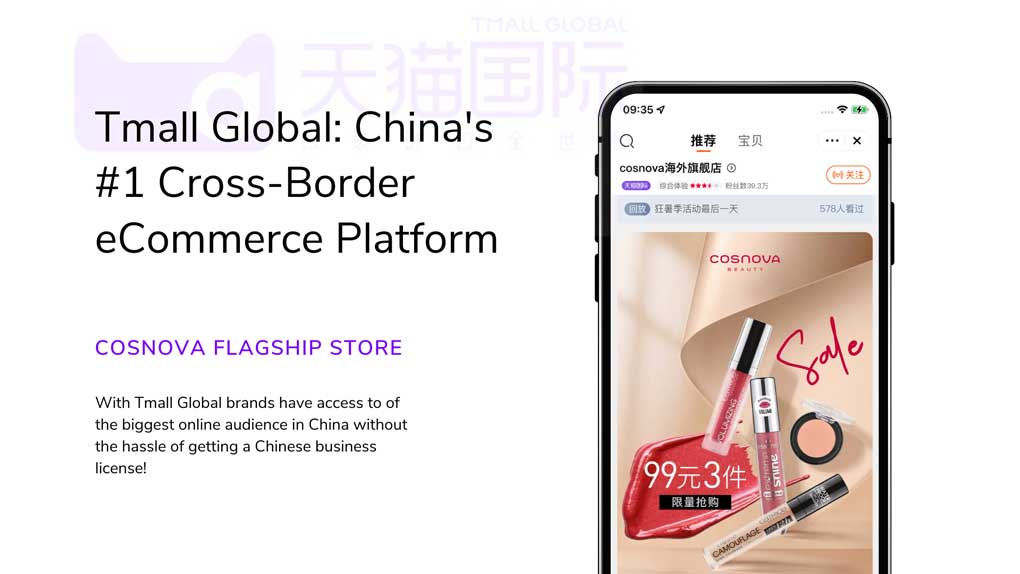
A Tmall Global flagship is a cross-border storefront with no local entity behind it. It is the cheapest way in, and the easiest thing to close. Source: Cosmetics China Agency media library.
I compared the brands that left with the brands gaining share in 2026. Four differences hold up every time. Nothing else does.
1. Product renewal speed, measured in months
Filorga spent ten years in China and once broke 100 million RMB of single-store sales at Double 11. The Chinese trade press attributes its decline to one thing: no influential new product for years (Winshang, January 2026). Chinese competitors ship a reformulation in one to two quarters. If your global NPD calendar runs 24 months and China-specific SKUs are not in it, you are permanently slower than the market, and no media spend fixes that.
2. Owning your own content and livestream operation
Filorga’s online sales ran almost entirely through third-party influencer promotion, with almost no brand self-broadcast (Winshang, January 2026). This is the most common failure I see. Brands that outsource all content to KOLs are renting demand. When the commission rises or the influencer moves on, the revenue leaves too. Chinese e-commerce is content-led now: without daily brand-owned Douyin and Xiaohongshu output and your own livestream slots, cost per order climbs every quarter until the store is unprofitable.
3. A local entity, not just a cross-border storefront
Notice what got closed in 2026: cross-border storefronts. A Tmall Global flagship needs no Chinese entity, no NMPA filing for general products in most cases, and no local team. That is exactly why it is easy to abandon. Brands gaining share have a local entity, offline distribution and a reason to stay when one quarter goes badly.
4. A member base you own
If all your customer relationships sit inside Tmall, you own nothing. Brands that survive downturns have a WeChat private domain with measurable repeat purchase. That asset lets you cut paid spend for two quarters without collapsing. Brands that leave discover they had no such asset the moment they stop buying traffic.
| Structural marker | Brands that exited in 2026 | Brands gaining share in 2026 |
|---|---|---|
| China-specific product launches | Rare or none for several years | One to three per year, often China-first |
| Brand self-broadcast on Douyin | Minimal, KOL-dependent | Daily, in-house or dedicated team |
| Legal presence | Cross-border only (Tmall Global) | Local entity, filings, offline points of sale |
| Owned member base | Platform-held customers only | WeChat private domain with tracked repeat rate |
| Segment position | Mass makeup, price-competing | Prestige, or a clear functional claim |
Two brands proving it is not about being foreign
The Estée Lauder Companies. Mainland China organic net sales rose 9% in fiscal year 2026, with reported net sales up 12% to 3.06 billion USD, and the business gained prestige beauty value share for a sixth consecutive quarter (The Estée Lauder Companies fiscal 2026 results, 19 August 2026). A foreign group, same year, same country, outperforming the market every quarter. What changed was not sentiment. It rebuilt around China-relevant launches and fragrance instead of defending legacy SKUs. A smaller brand cannot copy the budget. It can copy the decision to stop defending products Chinese consumers stopped asking for.
Mao Geping. Revenue of 3.267 billion RMB in the first half of 2026, up 26.2%, with colour cosmetics at 1.967 billion RMB, up 38.3%, and a gross margin of 84.8% (Mao Geping interim report, 27 August 2026). Makeup, the segment described as the most brutally competitive in China, growing 38% for one brand while an 8 billion RMB German makeup group exits. The difference is not the category. Mao Geping sells at prestige price points with in-store artistry service and an Eastern aesthetic point of view, and it spends to hold it: marketing expenses rose 44.2% in the same period. Offline was 46% of product sales. It is not a traffic brand.
The lesson for a mid-size brand is narrow. Both compete on a reason to pay more. Neither competes on price in mass makeup. If your China plan is a European mass-market price ladder, you are entering the one segment where nobody, foreign or Chinese, is making money.
What this changes for your brand, concretely
First, a Tmall Global store is not a China strategy. It is a test. If you have run it for 24 months without a China-specific product, a self-broadcast account and a member base, you have not tested China. You tested whether cross-border traffic buys your existing catalogue, and the answer was no.
Second, the price of entry moved up, not down. Traffic costs rose while price points deflated. Winners now spend on product adaptation and owned content, not launch campaigns.
Third, and this is the part agencies do not say: if your category has 60 credible Chinese competitors, your product has no defensible claim, and your global margin cannot absorb 18 to 24 months of losses, then do not enter. Spend the money in a market where you can win.
A conversation I had this week
Client · Managing director, European mid-market makeup brand
Client
Two years on Tmall, two years of losses. Cosnova just closed. My board wants to know if we close too. Tell me we are close to the turn.
Inna
I cannot tell you that. Answer three things first. How many products have you created for China in those two years? How many hours a week does your own team livestream? And how many customers can you reach next Monday without paying a platform?
Client
Zero, zero, and about four thousand WeChat followers we have never mailed.
Inna
Then you have not lost two years in China. You have spent two years paying a platform to show your European catalogue to people who had forty local options at a lower price. Closing the store will not teach you anything, and neither will keeping it open the same way.
Client
So what is the honest recommendation? We do not have budget for a five-year build.
Inna
Close the Tmall Global store. Keep the Xiaohongshu account alive and keep the WeChat list, they cost almost nothing. Take twelve months and the same budget to develop two products for Chinese skin tones and Chinese texture preferences. If you cannot fund that, China is not your next market, and saying so out loud is cheaper than another two years.
Client
My board will hear that as failure.
Inna
A closed store is a decision. A store that quietly loses money for five years is what failure actually looks like, and nobody ever has to present it.
Conversation reconstructed and anonymised. I have some version of it most weeks.
Who is actually buying, and at what price
Rational consumption (理性消费) replaced brand prestige. Chinese buyers in 2026 want a verifiable functional claim and a stable repeat experience. The trade press is blunt: domestic products are no longer a fallback option, and shoppers will not pay a premium for a foreign label on its own. That premium was the entire business model of imported mass makeup.
Self-pleasing spend (悦己消费) concentrated at two ends. Prestige with a story, and genuine value. The middle, 100 to 200 RMB imported makeup with no distinct claim, is where 2026 hurt most.
The purchase path starts outside your store. Discovery on Xiaohongshu or Douyin, verification in comments, purchase on Tmall, JD or in a Douyin livestream, repeat purchase through a WeChat private domain. A brand present only at the last step pays full price for every order forever. If your Tmall traffic is more than 70% paid, you do not have a brand in China yet, you have a media buy.
Seasonality hides the truth. 618 in June and Double 11 in November concentrate a disproportionate share of category sales. A weak brand survives on discount volume in those two windows and discovers in March that there is no underlying demand. Judge your China business on non-promotional months.
For a foreign brand, the implication is short. Build the reason to pay before you build the store.
What I would do instead, in order

Brand-owned content is the difference between renting demand and building it. Outsourcing all content to KOLs is the pattern I see in almost every brand that later closes. Source: Cosmetics China Agency media library.
Social first, and only two platforms
Start on Xiaohongshu, not Tmall. It is where beauty discovery and verification happen, and the cheapest place to find out whether Chinese consumers have a reason to want your product. Seed with KOC reviews in your specific use case, not big-name KOLs, and read the comments as product research. Add Douyin only when you can commit to daily brand-owned content and your own livestream hours. Below roughly 8,000 to 15,000 USD per month of sustained content and seeding, an entry test on Xiaohongshu is not a real test. That is a beauty number, not a general one. This is the core of our cosmetics marketing in China work.
E-commerce second, and choose the exit cost on purpose
Cross-border through Tmall Global is cheap to open and, as 2026 showed, cheap to close. Choose it knowingly as a test with a fixed budget and a fixed review date, or commit to a local entity with NMPA filings and domestic logistics. What does not work is a cross-border store run for years as if it were a market entry. Our Tmall store setup and operations page sets out what each route costs.
Digital marketing third, and own the audience
Build the WeChat private domain from the first order: service account, membership, repeat purchase tracking. Then Baidu SEO, and generative engine visibility on DeepSeek, Doubao, Kimi and Yuanbao, where a growing share of Chinese product research starts. The mechanism is simple: if the models cannot find structured, sourced information about your product claims in Chinese, they describe your competitors instead.
What closing actually costs you
If you do close, close properly. I have seen brands destroy their re-entry option in a week.
Keep the Xiaohongshu account and post monthly, even lightly. Keep the WeChat member list and mail it. Keep your trademarks registered in the relevant classes, because squatting in China is fast and expensive to undo. Keep your NMPA filings alive. Announce the closure as a channel change, not a market exit, and tell customers where they can still buy. Brands that did this came back. Brands that deleted everything started from zero, and the second entry cost more than the first.
Sources
- Winshang (赢商网), on the retreat of 20-plus foreign beauty brands from China, 2026. Documents the 2026 closure dates for Filorga, hince and ETUDE and the structural causes cited by the Chinese trade press.
- Qingyan Intelligence (青眼情报) data, reported by PEdaily, August 2026. Source of the H1 2026 market size, the 57.37% domestic share, the channel split and the selling expense ratios.
- The Estée Lauder Companies, “Reports Fiscal 2026 Results”, 19 August 2026. Source of the Mainland China organic growth and consecutive share gain figures.
- Huxiu (虎嗅), on the rare negative growth of the beauty category at 618 in 2026, July 2026. Source of the 618 decline and the eight-month average lifespan of traffic-driven Chinese makeup brands.
Related reading on this site: why L’Oréal and Proya are buying minority stakes in young C-beauty brands, the mineral and clean makeup market in China in 2026, and the rise of C-beauty.
Working with us on this decision
Cosmetics China Agency works only with beauty, health and wellness brands in China. We refuse everything else, because platform mechanics and regulatory filings are category-specific. On this question, exit or continue, what we do is unglamorous: we audit your paid-to-organic traffic ratio, your repeat purchase rate outside promotional windows, your product renewal pipeline, and the member base you actually own. Then we tell you which of the four markers you are missing, and whether they are fixable at your budget. Sometimes the answer is to stop. We would rather say it than bill you for three more years.
One case, anonymised because the brand is still trading. A European colour cosmetics brand came to us in 2024 after eighteen months of Tmall Global losses. We closed the store, kept Xiaohongshu at a low monthly spend, kept the WeChat list, and spent the redirected budget on two China-specific shades and a lighter texture developed with a local lab. They reopened fourteen months later, on Douyin first with their own daily livestream, and reached break-even on contribution margin in the second quarter after relaunch. The product work was the variable. Nothing about the media plan was clever.
If you are in that managing director’s position, write to us with your traffic split and your repeat rate. Those two numbers tell us more than a deck.
Inna Kowalsky is the founder of Cosmetics China Agency, based in Shanghai. She has spent the last decade opening, running and, in several cases, closing China channels for foreign beauty brands, which is why this article is written from the closing side as much as the opening one. Her agency works on beauty, health and wellness only. Connect with her on LinkedIn.


