

South Korean beauty products have witnessed a growing interest among Chinese customers at the expense of western brands for many years. However, this is not the case now. Demand from China and other emerging markets boosts Korean cosmetic exports by 4.2% in 2019. South Korea’s cosmetic export value exceeded USD 6.5bn in 2019. China is the top buyer of Korean cosmetic products by spending USD 3.06bn, accounting for 46.9% of the total export shares. Exports of Korean cosmetics to mainland China increased 14.3% in 2019, South Korea’s cosmetics exports rise at the slowest pace in 8 years in 2019, K-beauty is now competing with rising local brands and struggling to adapt to Chinese changing consumer habits. The demand for Korean cosmetics is facing a growth bottleneck in the Chinese market.
South Korea, once the challenger in the beauty industry.
As China’s economy was slowing down by a notch, Chinese outbound tourists reconsidered their choice as regards their destination, South Korea stood out. This recent trend for tourism in South Korea led the countries beauty brands to be more exposed to Chinese consumers. It ensured a gradual growth of the South Korean beauty products popular among Chinese customers.
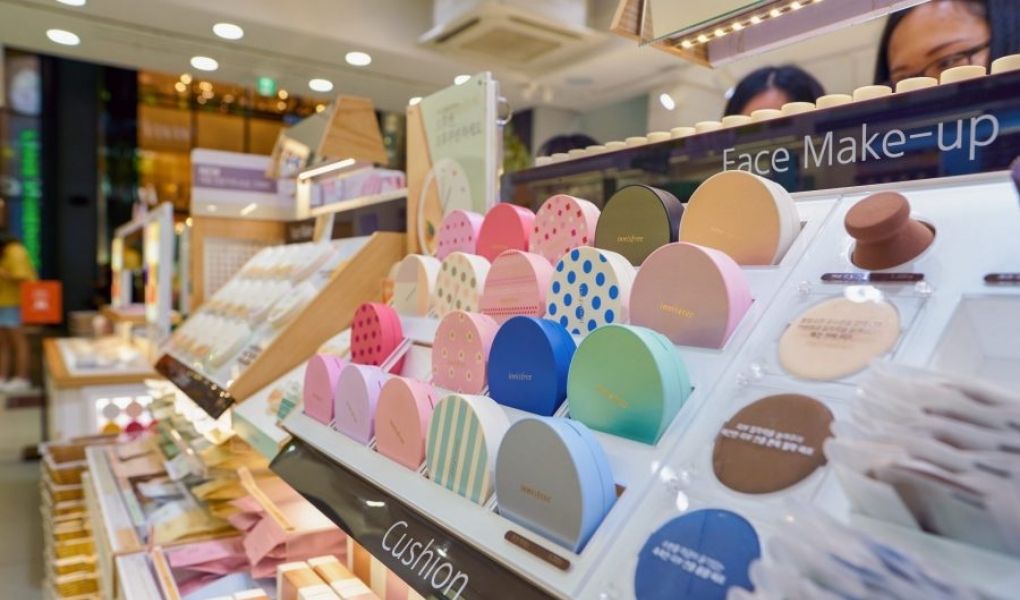
According to a report from the luxury bench marker L2, Chinese interest in western beauty & cosmetics products was slightly declining whereas South Korean beauty had seen strong results. Figures showed that about one-quarter of the cosmetic imports in China came from their neighbor South Korea. The research director of L2 declared that South Korea is the source of beauty innovation and that numerous products originating from it were copied by several western brands (including bb cream and cushion compacts).
South Korean cosmetic products were on the verge of seriously contending with western brands as the online and offline brands were developing their market. Chinese beauty bloggers and vloggers already started to talk about these rising beauty products, introducing them to a broad audience made of millions of Chinese potential customers.
Read as well: China K-Beauty market guide
What were the main factors for the South Korean cosmetics fever in China?
K-pop & Cosmetics: more fashion
The rising popularity of fashion magazines, beauty bloggers & vloggers, the K-pop celebrities is furthering the expansion of the South Korean beauty industry in China. Reports showed that the value of South Korean products imported to China has increased by 250%, 126% of which come from beauty products only. The western brands that had settled on the Chinese market long ago, are witnessing a fall in Chinese interest.
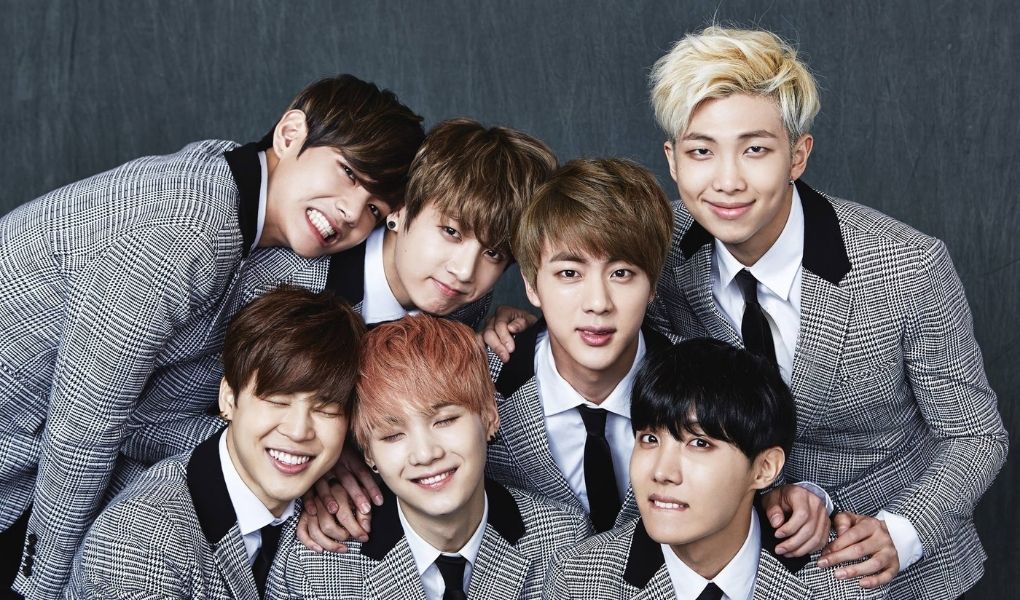
It appears that South Korean beauty brands are mastering the online channel, ensuring a better reach in the Chinese market. Maybe the fact that South Korea is closer to China in terms of culture, helps the beauty brands to better grasp the expectations of Chinese consumers.
Efforts by Korean brands in Chinese Internet
Further research carried out by L2inc showed that Korean brands’ popularity on Chinese search platforms is growing, especially on Baidu and Weibo. This recent rise in popularity includes search, social, and e-commerce platforms. Several of the most famous Korean brands such as Innisfree, Laneíge are doing quite well on the Chinese web.
Laneíge had an index on Baidu of 11,194, a growth of 89% during just about a year. Although western brands like Kiehl’s, Estée Lauder, Sephora and Lancôme (owned by LVMH) still lead the Baidu index. Laneíge stands at the top of Weibo, being mentioned on the blogging platform more than 2,100 times every month. South Korean beauty products are mentioned more than 42 times the index average.
Digital-savvy Korean brands
Apart from their ascendance to the search platforms, Korean brands already secured a good position on Chinese Alibaba’s Tmall e-commerce platform. The three of them are among the top 10 searched brands, competing with famous western brands as L’Oréal Paris, Channel, and Estée Lauder as well as local brands and Japanese Shiseido.
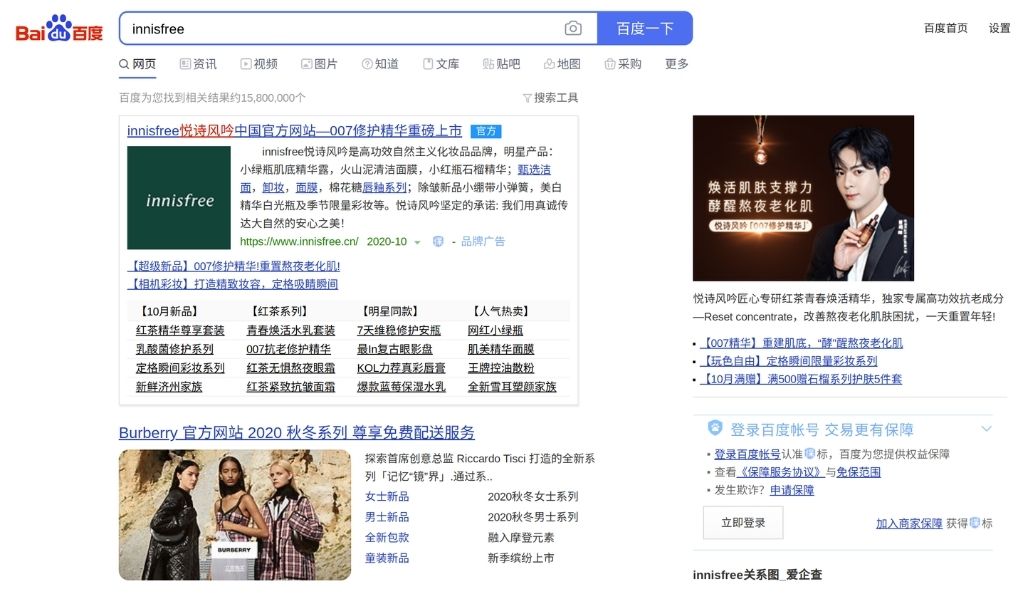
Innisfree is the current king, leading the search volume on Baidu, Taobao (Tmall), and Youku. Innisfree successfully complied with the Chinese market characteristics as the brand used K-pop celebrities to advertise their products, and formulated a campaign with social content featuring WeChat. One of the WeChat posts had over 10,000 views while the campaign had around 17.7 million impressions and 36,000 mentions on Weibo.
Great investment in the Chinese Web Communication
The South Korean brands really know what is up on the Chinese internet. Laneíge has been reported to currently increase its reach on WeChat and Youku, further increasing its view index quite above average. Korean brands use every possible Chinese digital channel to gain Chinese consumers’ attention. Weibo, WeChat, Xiaohongshu, etc.
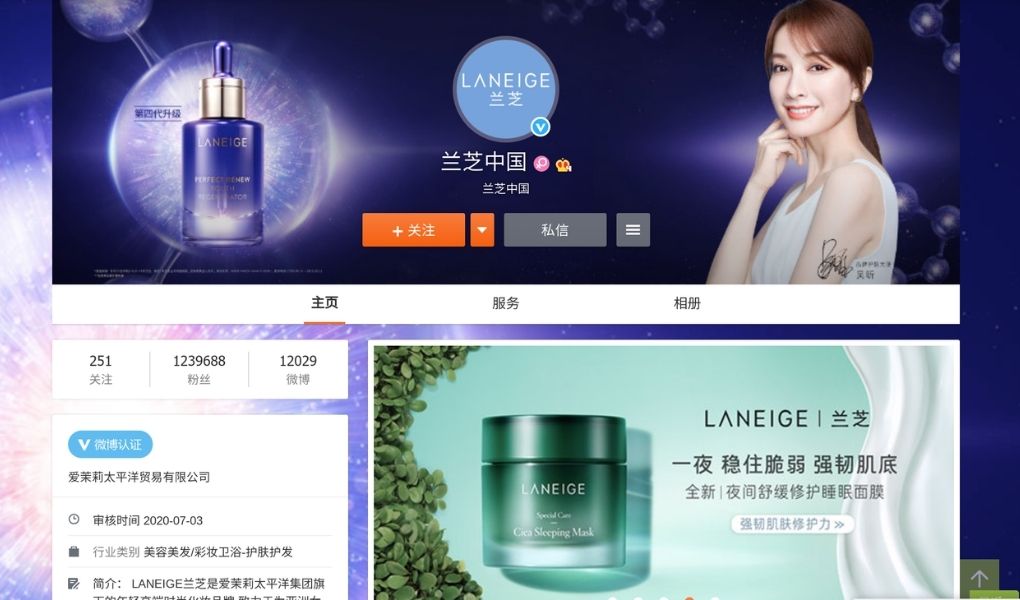
Laneíge’s effort on the Chinese internet platforms was successful as their video “Fashion in Seoul” featuring someone using WeChat, was seen more than 2 million times on Youku. Furthermore, Korean drama shows are witnessing strong growth in popularity among the Chinese people, the TV show “Descendants of the Sun” in March 2015 strategically starring Laneíge’s spokesmodel Kang Mo Yeon, reached over 440 million viewers across China.
All in all, South Korean brands do know how to appeal to the growing Chinese market, their firm stands on the online platforms is already bearing fruits and still, they are still willing to expand their reach.
What has caused the decelerated growth of Korean cosmetics products in China?
THAAD has evoked a boycott against Korean products in China
Although Korean culture and beauty products are very popular in China, a political problem has influence strongly their market in China in 2017. US THAAD missile system on the Korean peninsula has led to the import quota on South Korean goods and the country’s cultural influence.
As presented in the beginning, Korean Cosmetics in China grew just 13.7% in 2017, while it was 87.3 % in 2010. China was still the biggest consumer of South Korea’s cosmetics products in 2019, however, Chinese customers are more and more interested in alternative options, since there are so many cosmetics brands in the market.
“Fast beauty” brands lack in R&D
Korean cosmetic products are very popular for their fast fashion mode which allows consumers to have new products all the time, but this kind of mode leads to middle- and low-end product categories. Normally, for those big brands who are famous for their high quality, they need more than a year in the R&D, while this approach allows Korean brands to launch a new product in just 4 months.
On one hand, as the rising affluence in China, consumers tend to pay for premium products, despite higher prices; on the other hand, due to the rapid development of low- and medium-priced domestic brands in China, the market positioning of Korean small and medium-sized enterprises is not very promising.
When Chinese consumers buy low- and medium-priced products, they prefer to choose domestic products, and when buying high-end cosmetics, they will choose imported products coming from for example France or the USA but Korea. In this case, Korean products are losing their market in China.

Do you want to know if your products or brand is suitable for the Chinese market and how it works? GMA, an expert in Chinese digital marketing and foreign business in China, can give you the answer and help you to win the market. Feel free to contact us, the first 30 mins of the call are free and you can also come by to our office in Shanghai.