

Service
Digital Marketing Agency in China (Shanghai)
A single digital marketing plan across Baidu, Xiaohongshu, Douyin, WeChat and Tmall, built on 2026 China data


01
Market Audit
We start every engagement with a real market audit, not a template. That means checking where your category actually sits: Chinese domestic beauty brands now hold 57.4% of the total cosmetics market, a fifth consecutive year of share gains, and Douyin overtook Tmall as the top GMV driver for beauty e-commerce in 2025. Entering blind, without knowing which platform and which competitors you are actually up against this year, is how budgets get spent on channels that were already the wrong bet before the campaign launched.
When we ran this audit-first approach for Nano Japan, a health and beauty brand entering China from Singapore and Japan, the resulting WeChat, Weibo and Baidu SEO push delivered +3,000 WeChat followers and +6,000 Weibo followers in the first month alone, plus a top Baidu ranking for their category.

02
Baidu SEO & SEM
Baidu still handles the large majority of organic search in China, and 2026 changed the game again: Baidu's own AI answer layer now summarizes results before a searcher clicks through, so ranking the old way is only half the job, getting cited as a source inside the AI summary is the other half. SEM works as a managed auction, typically $0.50-$2 per click, and is best used as a bridge while organic content and off-site authority are still being built out.
We build for both audiences: classic Baidu ranking through ICP-aware hosting and Chinese-native keyword research, and the newer AI citation layer, which favors registered, credible sources over anonymous pages.

03
Online Reputation
Reputation in China is distributed across more places than most brands check: Baidu Baike (its Wikipedia-style encyclopedia), Zhihu Q&A, Xiaohongshu reviews, and press coverage all feed into whether a Chinese consumer trusts you before buying. About 74% of Chinese consumers report making purchase decisions based on influencer or peer recommendations, against a 30% global average, which makes this distributed reputation layer more decisive here than in most markets.
We build and maintain this footprint directly: securing a proper Baike entry, seeding credible Zhihu answers, and monitoring sentiment so a small issue gets caught before it becomes a Weibo-scale reputation problem.

04
China eCommerce
E-commerce in China means choosing between Tmall, Douyin, Xiaohongshu shop and Pinduoduo's cross-border channel, each with different registration costs, timelines and audience behavior. Once a brand's annual cross-border sales exceed RMB 1 million on a platform, Chinese regulators now expect general trade-level compliance rather than lighter cross-border filing, a threshold that catches brands off guard mid-growth.
We register, build and run the store end to end. SPA Ceylon, the Sri Lankan ayurvedic beauty brand, saw a 200% return on investment on their Tmall flagship store after we rebuilt their store structure and campaign calendar around China's actual shopping festival cycle.

05
Influencer Marketing
Chinese social media is not one channel: WeChat holds CRM and loyalty (over 1.4 billion monthly users), Douyin drives discovery through short video and live commerce (907 million monthly users), Weibo carries public conversation (562 million monthly users), and Xiaohongshu functions as a research layer where roughly 80% of activity is product-related. A single global content calendar translated into Chinese misses what each platform actually rewards.
We write and produce for each platform's own grammar and run them as one coordinated plan tied to the same customer data, not four disconnected vendors.
06
Chinese Social Media
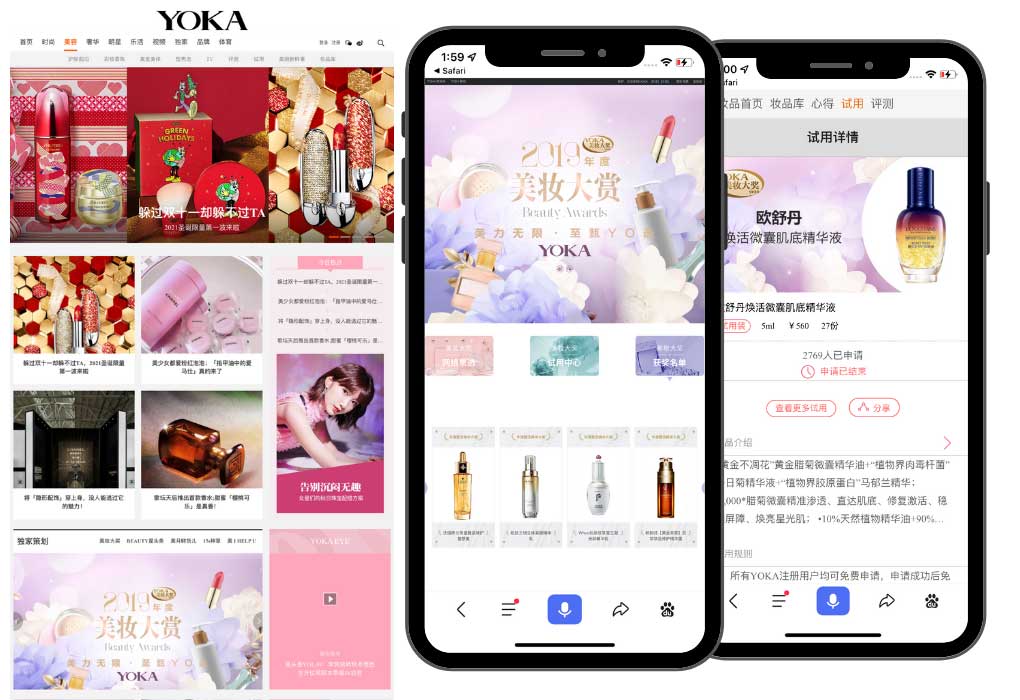
Influencer marketing in China runs on different economics than the West. KOC (Key Opinion Consumer) campaigns typically deliver 5-15% engagement, against 1-3% for traditional KOL posts, which is why over 60% of Chinese brands now combine both tiers rather than betting on a single big name. Vetting matters just as much as reach: roughly 39% of brands globally report suspected or confirmed influencer fraud, and China's livestreaming sector specifically has seen documented cases of fabricated engagement.
When we ran a 30-KOL campaign for Yves Rocher across Chinese social platforms, the brand saw a 30% increase in social media exposure in a single coordinated push.
In detail
Our services for digital marketing strategy in China
-

Market Audit
Market surveys and consumer insights will help you better understand the Chinese cosmetic market and decide on the best strategy for your brand.
-

Baidu SEO & SEM
SEO and SEM are extremely relevant in the cosmetics industry if you need to stand out from your competitors and gain visibility in China.
-

Online Reputation
Reputation is very important to Chinese consumers, because they don’t trust the brands they never heard of. We will take care of your online presence in China!
-

China eCommerce
We offer registration and management services for your brand on China’s most popular e-commerce platforms and online marketplaces.
-

Social Media Marketing
Chinese social media platforms are were Chinese people look for brands and products recommendations.
-

Influencer Marketing
We link you with the right Key Opinion Leader for your brand and target audience.
Approach
Our services for digital marketing strategy in China

SEO / SEM
SEO and SEM are extremely relevant in Cosmetics industry if you need to stand out from your competitors.

Online Reputation / e-Reputation
Increase your reputation online will bring you more notoriety among Chinese consumers since they are always connected.

E-Commerce in China
E-Commerce is definitely trending in China nowadays, even more in Cosmetics industry.

Market Survey
Market Surveys and Consumers Insights will help you understand better the Chinese cosmetic market in order to better tackle it.
Why us
Why Hire us for Your Digital Marketing in China?
We are a China-based digital marketing agency offering the full stack a beauty brand needs: Baidu SEO/SEM, Xiaohongshu and Douyin content, WeChat CRM, KOL and KOC campaigns, and e-commerce store management across Tmall, JD and Douyin shop. Most agencies specialize in one of these and hand you off to a different vendor for the rest. We run them as one plan with one reporting view, because a Xiaohongshu post, a Baidu ranking and a Tmall listing are not separate projects, they are three touchpoints in the same customer's decision.
Results across our client base: Nano Japan gained +3,000 WeChat and +6,000 Weibo followers in one month. SPA Ceylon saw 200% ROI on their Tmall flagship. Yves Rocher saw a 30% increase in social exposure from a 30-KOL campaign. Different brands, different platforms, the same integrated approach.
China's digital landscape changes every quarter, Douyin overtaking Tmall for beauty GMV in 2025, Baidu's AI answer layer reshaping search in 2026, WeChat Channels pulling budget away from Official Accounts. A plan built on last year's platform rules is already out of date. We rebuild the channel mix as the platforms shift, instead of running the same playbook until it stops working. Explore our e-commerce, social media and KOL services for the detail behind each discipline.


Questions
China Digital Marketing - Frequently Asked Question
Why is digital marketing the best way to promote cosmetics in China in 2026?
Because the entire consumer journey now happens across a handful of connected digital platforms rather than through traditional retail or advertising. A Chinese shopper typically researches on Xiaohongshu (roughly 80% of activity there is product-related), checks Baidu and Zhihu for credibility, watches Douyin content for entertainment and discovery, and buys on Tmall, Douyin shop or via a WeChat Mini Program, often within the same week. Chinese domestic beauty brands already hold 57.4% of the market and keep gaining share by moving fast across exactly this stack. A foreign brand relying on traditional retail presence or a translated Western campaign simply is not visible at any of these decision points. Digital marketing in China is not a channel choice, it is the only realistic way to reach a Chinese beauty consumer where they actually make the decision to buy.
Start here
Get your China baseline
An audit of where your brand stands in Chinese search, social and marketplaces, and what entry will cost.
Book the audit