Skip to content

Service

China E-Commerce Agency for Brands (Shanghai)

Tmall, Douyin and Xiaohongshu storefronts built and run for cosmetics brands entering China in 2026


01

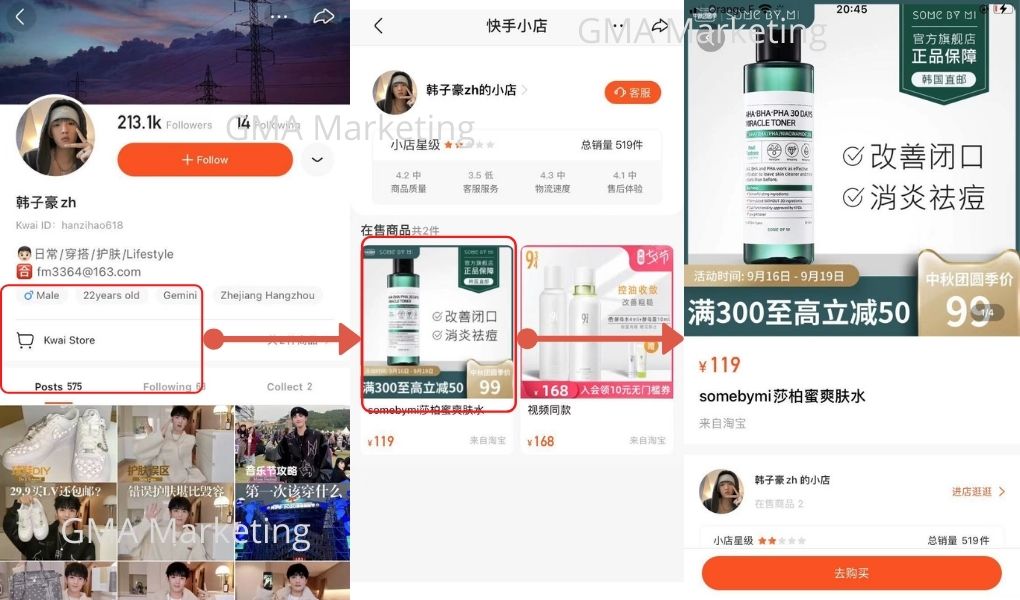
Store Registration and Management

The platform question changed in 2025. Douyin overtook Tmall as the top GMV driver for beauty e-commerce in China, though Tmall still holds 44-50% of major online retail beauty GMV and remains the safer entry point for brands that need the trust signal of an official flagship store. Which one is right for you depends on budget and product type, not on which one is trendier this quarter.

Registration rules tightened too. Once a brand's annual cross-border e-commerce (CBEC) sales exceed RMB 1 million on a given platform, Chinese regulators now expect compliance closer to general trade import requirements, not the lighter CBEC filing that used to cover most new entrants. Special-use cosmetics, sunscreen, hair dye, anti-hair-loss and whitening products, now need NMPA registration once you cross that volume, even under CBEC. Only products whose HS code sits on the official positive list, 26 cosmetic categories including masks, shampoo and perfume, can even use the CBEC channel at all.

Once registered, your store needs to be built for how Chinese shoppers actually decide: dense product descriptions, full ingredient lists, and photos that answer every question before a customer has to ask a live chat agent. Every major platform runs its own calendar of shopping festivals, and shoppers expect a brand to show up with a real offer on each one, not just a banner.

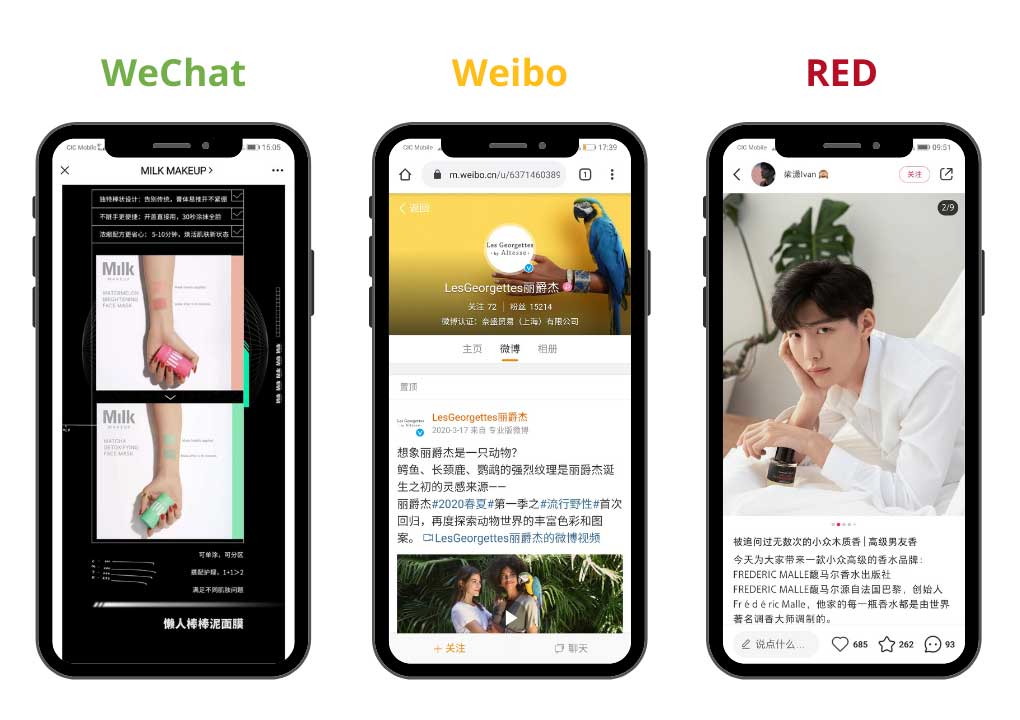
COSMETICS BRAND PRESENCE ON CHINA SOCIAL MEDIA

02

Off-site Promotion

A storefront with no off-site presence does not sell. Xiaohongshu functions as a discovery and trust layer rather than a transaction platform: roughly 300 million monthly active users research a product on Xiaohongshu before buying it somewhere else, on Tmall, Douyin, JD or Pinduoduo. If your brand is invisible there, shoppers arrive at your store with no context and no reason to trust you over a domestic competitor.

Live commerce is where the money actually moves. China's live commerce market is on track to cross USD 1 trillion in 2026, led by Douyin and Kuaishou, and the average Chinese live-commerce buyer already spends far more per year than shoppers anywhere else. A single well-run livestream, with the right host and the right offer, can outsell a month of static listing traffic.

We saw this directly with Nano Japan, a health and beauty brand entering China from Singapore and Japan. Running WeChat, Weibo and Baidu SEO together as one off-site push, not as separate campaigns, got them +3,000 WeChat followers and +6,000 Weibo followers in the first month alone, plus a top ranking on Baidu for their category. That kind of visibility is what makes the on-platform store convert once a shopper actually lands on it.

In detail

Our eCommerce services for Cosmetic Brands in China

  • Project Audit

    A complete market research and analysis of your budget and current status in China will help us choose the best Chinese eCommerce plateform to sell your products.

  • eCommerce registration

    Registering on Chinese eCommerce apps can be a huge headache, let us take care of it, save you some time and money.

  • Shop Design

    Design a beautiful store + listing & stock management

  • On-site Marketing

    run in-app campaign, manage customer services

  • Offsite branding & e-reputation

    Ereputation is crucial for your conversion rate. Off-site marketing is the answer.

  • Monthly Report

    A detailed report so you know how your budget is spent & Optimisation

Approach

Our services for your e-commerce in China

E-commerce in China

E-Commerce is Chinese consumers' new way of purchasing, it is crucial to have your own e-shop business, especially in cosmetic market.

SEO / SEM

SEO and SEM are relevant if you want your e-shop to rank better on search engines, especially in Cosmetics industry.

Branding

Having an e-commerce platform will lend further credibility to your brand and increase its popularity.

Distribution Consulting

Choosing the right distribution channels to support your e-commerce will make your brand stand out from your competitors.

Why us

Why hire us for your eCommerce in China?

Letting an experienced agency handle registration should be reason enough. E-commerce in China is more competitive than it was even two years ago: Chinese domestic beauty brands now hold 57.4% of the total cosmetics market, a fifth straight year of share gains, and they are winning that share with platform-native pricing and formats that took foreign brands years to understand. Douyin overtaking Tmall for beauty GMV in 2025 is only the most visible sign of how fast the ground moves under this market.

Regulation adds a second layer most brands underestimate. The ICP Commercial License required to run your own transactional site in China can only be held by a 100%-Chinese-owned company, or a joint venture where foreign ownership is capped at 50%. Most foreign beauty brands cannot hold it outright, which is exactly why marketplace flagship stores, run through the right partner, are usually the faster path to market. We are a certified Tmall Partner (TP), which means we can run that flagship relationship directly.

Result: SPA Ceylon, the Sri Lankan ayurvedic beauty brand, saw a 200% return on investment on their Tmall flagship store after we rebuilt their store structure and campaign calendar around China's actual shopping festival cycle.

We have run this same playbook for Nano Japan (WeChat, Weibo and Baidu visibility from a standing start), DHA France (Tmall Global entry for a European health supplement brand with no China awareness), and Biotherm, part of L'Oreal Group, defending category leadership in men's skincare against C-beauty competitors. Three different brand sizes, three different platform strategies, the same discipline: audit first, pick the platform that fits the budget, then run registration, store and off-site promotion as one connected plan instead of three separate vendors.

Case studies

Our China eCommerce Case Study

Questions

Sell Cosmetics Brand on China eCommerce Platforms- Frequently Asked Question

Do I need my own e-commerce website to sell cosmetics in China in 2026?

Not as your main channel, but it still helps. A standalone site cannot be your primary store because the ICP Commercial License needed to run one is capped at 50% foreign ownership, so most foreign brands route sales through marketplace flagship stores instead. What your own site does well is SEO visibility and a sense of legitimacy when a Chinese shopper checks whether your brand is real before buying on Tmall or Douyin.

Should I launch on Tmall or Douyin first in 2026?

Depends on your goal. Tmall still holds 44-50% of major online beauty GMV and remains the trust-building choice for a first official flagship store, especially for CBEC entry. Douyin overtook Tmall as the top GMV driver for beauty in 2025 through live commerce, but growth there slowed sharply by early 2026, down 1.13% year-on-year in February, a sign the platform is maturing rather than still exploding. Most brands we work with launch a Tmall store for credibility and run Douyin live commerce for volume, rather than picking one over the other.

What changed in cross-border e-commerce regulation for cosmetics in 2025-2026?

The big one: once a brand's annual CBEC sales exceed RMB 1 million on a platform, regulators now expect general trade-level compliance, not the lighter CBEC filing most new entrants used before. Special-use products, sunscreen, hair dye, anti-hair-loss, whitening, now need NMPA registration past that threshold. Only products on the official 26-category positive list can use CBEC at all. A new customs rule, GACC Decree No. 284, takes effect December 1, 2026 and formalizes risk-based inspection for cosmetics imports, so expect more consistent enforcement, not less.

What are the legal requirements for running e-commerce in China as a foreign brand?

Two separate ICP registrations exist: an ICP Filing for non-commercial sites, and the ICP Commercial License for any site that sells goods, takes payment or carries ads. Foreign companies cannot apply directly. You need an onshore vehicle, a WFOE, a joint venture, or a partner, before China's Ministry of Industry and Information Technology will even accept the application, and the commercial license itself is capped at 50% foreign ownership. Processing typically takes two to three months, and in 2026 a content-moderation plan and a PIPL-aligned privacy policy are standard checklist items, not optional extras.

What marketing actually drives e-commerce sales in China right now?

Xiaohongshu drives discovery, not transactions: about 300 million monthly users research a product there before buying it on Tmall, Douyin, JD or Pinduoduo. If you are invisible on Xiaohongshu, shoppers land on your store with zero context. Live commerce is where volume comes from, China's live commerce market is on track to pass USD 1 trillion in 2026, led by Douyin and Kuaishou. The brands that win combine both: XHS content to build the intent, live commerce to close it.

How important is mobile and live commerce for a cosmetics brand in China?

It is not optional. Mobile accounts for over 65% of online sales in China, and live commerce spend per buyer there is the highest in the world, previously benchmarked around USD 1,550 per year per active buyer. A store that is not built mobile-first, with fast load times and a livestream-ready product page, is competing at a structural disadvantage before a single ad runs.

What are the real challenges of cross-border e-commerce in China today?

Two, mainly. First, compliance: the RMB 1 million CBEC threshold and the 26-category positive list mean brands can no longer treat cross-border as a permanent loophole around registration. Second, platform dependency risk: Temu's US daily users fell roughly 48% within two months in 2025 after the US ended a tariff exemption, a reminder that policy shifts outside China can hit a cross-border brand's traffic overnight. Brands need a local partner who tracks both sides of that risk, Chinese regulation and the platform's own policy shifts.

Which platform is best for a smaller beauty brand entering China in 2026?

Tmall's requirements and budget threshold are high, and we generally do not recommend it as a first move for smaller brands. Xiaohongshu, Douyin's shop features, and Pinduoduo's cross-border channel (0 commission, 0 deductions on many listings) are more accessible starting points, and they lean into social commerce, letting a smaller brand build a reputation before committing to a full Tmall flagship build-out.

Start here

Get your China baseline

An audit of where your brand stands in Chinese search, social and marketplaces, and what entry will cost.

Book the audit