

For the first time in China, after a long period of international brand supremacy in the field of cosmetics, a made-in-China cosmetic brand seems to threaten the pre-established order.
This Chinese hero is Perfect Diary, a relevantly new Chinese cosmetic brand that has disrupted China Cosmetic Market.
Thanks to its exceptional and forward-looking strategy, Perfect Diary, also known as PD or “完美日记”, marks the transition to new market rules, where brands are nimbler subjects that capitalize on trends.
A Quick Look at the Chinese Cosmetics Market
The cosmetic retail market in China continues to grow. China’s beauty market has experienced significant growth, generating approximately $430 billion in revenue in 2022, with retail sales falling just below $58.16 billion.
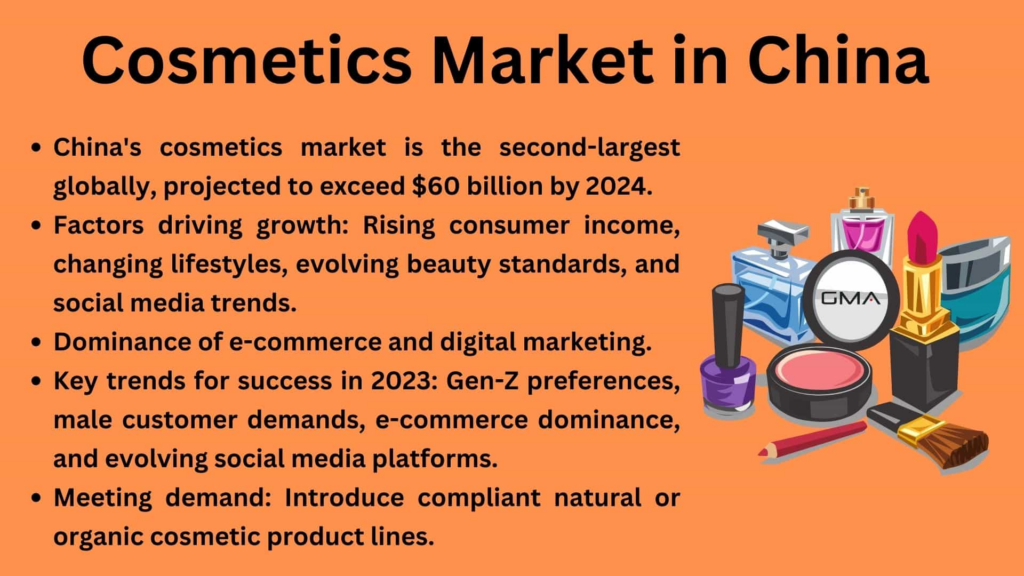
The projections show that the Chinese cosmetics market is expected to experience significant growth, making it an appealing option for investors and entrepreneurs.
Additionally, the high-end beauty market in China has already reached a value of 587.9 billion yuan in 2021, indicating the potential for luxury cosmetics brands to succeed in this profitable market.
In addition, even if current market conditions are good, the forecast for the future is even better since second-tier cities’ demand is constantly growing and the attitude of Chinese men toward skincare is becoming more and more positive.
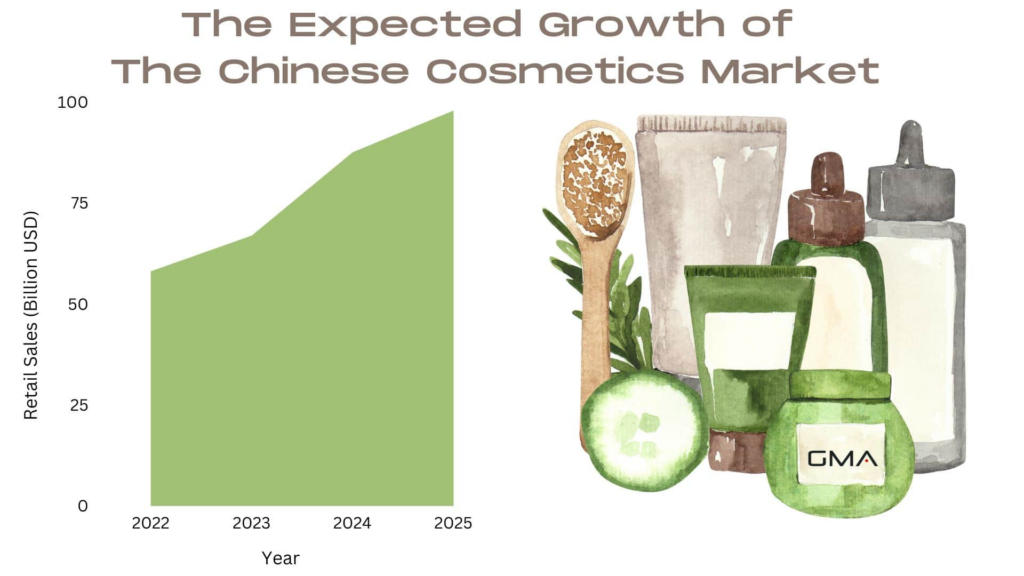
Chinese opinion of made-in-China cosmetic brands has changed
Before Perfect Diary entered the market in 2016, the Chinese didn’t trust domestic brands. This negative attitude has been generated by different events that tainted Chinese trust in the domestic manufacturing market.
Among these, for example, there is the famous “counterfeit milk formula” event.
So, aware of the high barriers of the market, PD acted on an original and creative strategy that led the company to success.
Perfect Diary, a Chinese Brand Competes with International Cosmetics Giants
Nowadays, the market of cosmetics belongs almost all to international brands. In fact, seven out of ten leading beauty and personal care product brands are foreign-funded.
Although data show stable market conditions for international players in China, the arrival of Perfect Diary has, however, undermined such positive dynamics and demonstrated how small companies can compete with long-lived global groups.
Evidence of this has been shown when Perfect Diary finally reached third place in China’s color cosmetics market. Also, when repeatedly ranked 1st in sales volume on Tmall among all cosmetics brands.
How Does Perfect Diary Reach Its Target?
Due to the lack of confidence of Chinese consumers in the quality of made-in-China products, Perfect Diary chose many foreign Original Equipment Manufacturers (OEMs) to produce its cosmetics.
In addition, attention to design and adaptation of it to the taste of its target has been a key factor to lead PD to success.
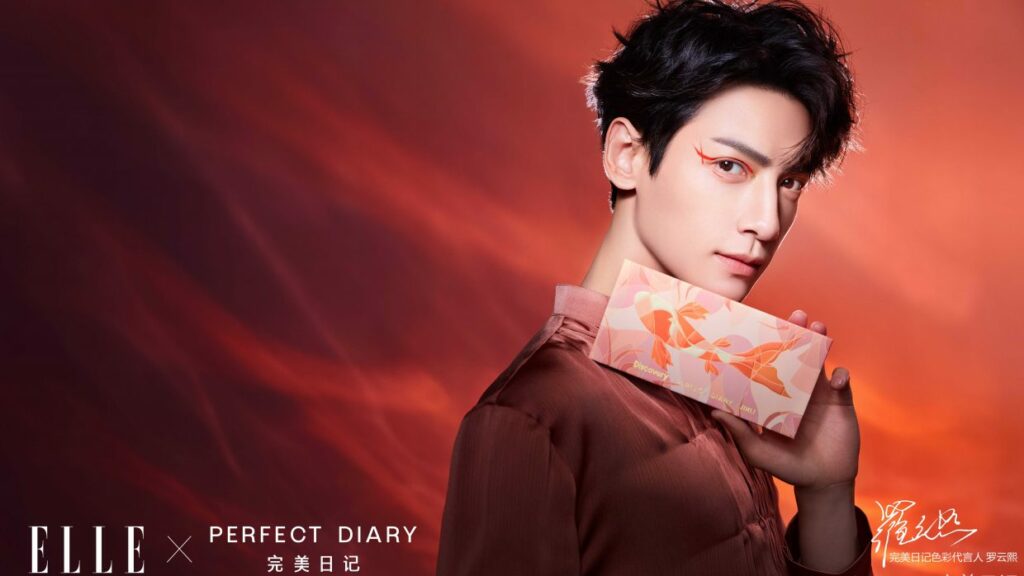
As Perfect Diary’s core target is Gen Z, a difficult-to-reach audience used to purchase high-quality products and no longer satisfied with regular marketing methods, then PD tries to be as much as possible creative.
This year, for example, the fashion brand reinvents itself and decides to expand the interpretation of its logo. PD actually no stands anymore just for Perfect Diary, but “P” for “Perfection” and “D” for “discovery, different, and diversity”. In perfect alignment with its audience’s attitude towards beauty.
The perfect mix of Collaboration & Design
From cooperation with important institutions such as the New York Metropolitan Museum of Art and the British Museum to PR with famous magazines like National Geographic or Vogue, to “more modern” collaboration with KOLs and KOCs.
Then, from all these partnerships, original and sexy packages with a unique design have been created.
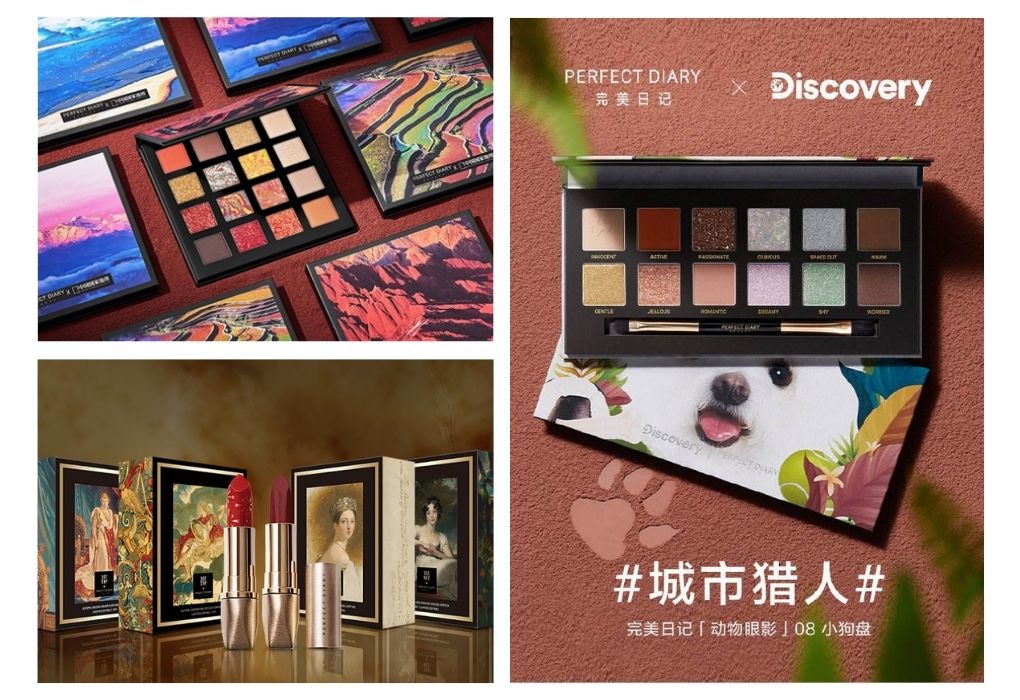
For instance, the partnership with the Metropolitan Museum of Art generated an elegant limited-edition of lipsticks, which shows the famous eight royal portraits on the packages.
Instead, a series of glamour palettes is born from the collaboration with Austin Li’s puppy. Not by chance, pets have become a trend in recent years.
Perfect Diary Social Media Strategy is the perfect case study
The C-Beauty unicorn Brand has cleverly used social media to achieve the following outcomes:
- Brand Awareness
- Consumers trust
- Generate a sense of community
- Xiaowangzi on WeChat for customer communication
1. Brand Awareness. PD has raised brand visibility by collaborating with KOLs on Weibo
Weibo, ‘China’s Twitter, is an ‘open’ network where users can see posts from everyone. This feature allows companies to build visibility and brand awareness.
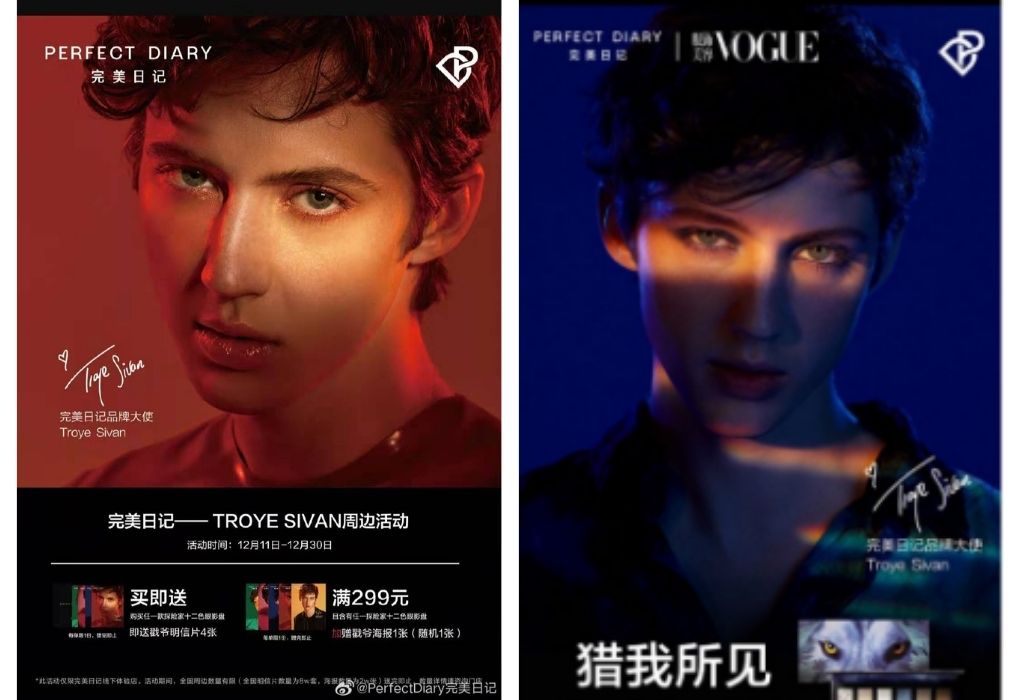
The latest brand ambassador of Perfect Diary is Troye Sivan. The musician posted the news on Weibo promoting a stylish PD animal eye palette, which is sold with his autographed photos.
The campaign definitely gets the attention of young Chinese: the post on Weibo received more than 3 thousand comments and 50 thousand likes within 2 days; also, and, a 45-second video (produced in collaboration with Vogue China and Dave Meyers) received 1.7 million views.
2. Customer trust. PD has built confidence working with KOCs on Xiaohongshu
Similar to Instagram but with e-commerce features, Xiaohongshu, or Little Red Book, is the most popular app among Chinese girls, whose objective is to “educate” the user about a certain product.
In addition, the app doesn’t host real advertising and this creates a strong engagement between Key Opinion Consumers (KOCs), followers, and the brand.
In 2019, Xiaohong Shu announced the addition of live streaming, which has rapidly become the biggest digital Chinese trend of the year. Of course, it is an interesting tool for marketers since allows showing the products in a more realistic and detailed way. This tool, together with the possibility to receive “shopping notes” (reviews about the products), are incredible weapons for sellers.
As you can guess, the “beauty Unicorn” has been able to gain the trust of many consumers by using these amazing features.
3. Sense of community. Perfect Diary creates a community through WeChat
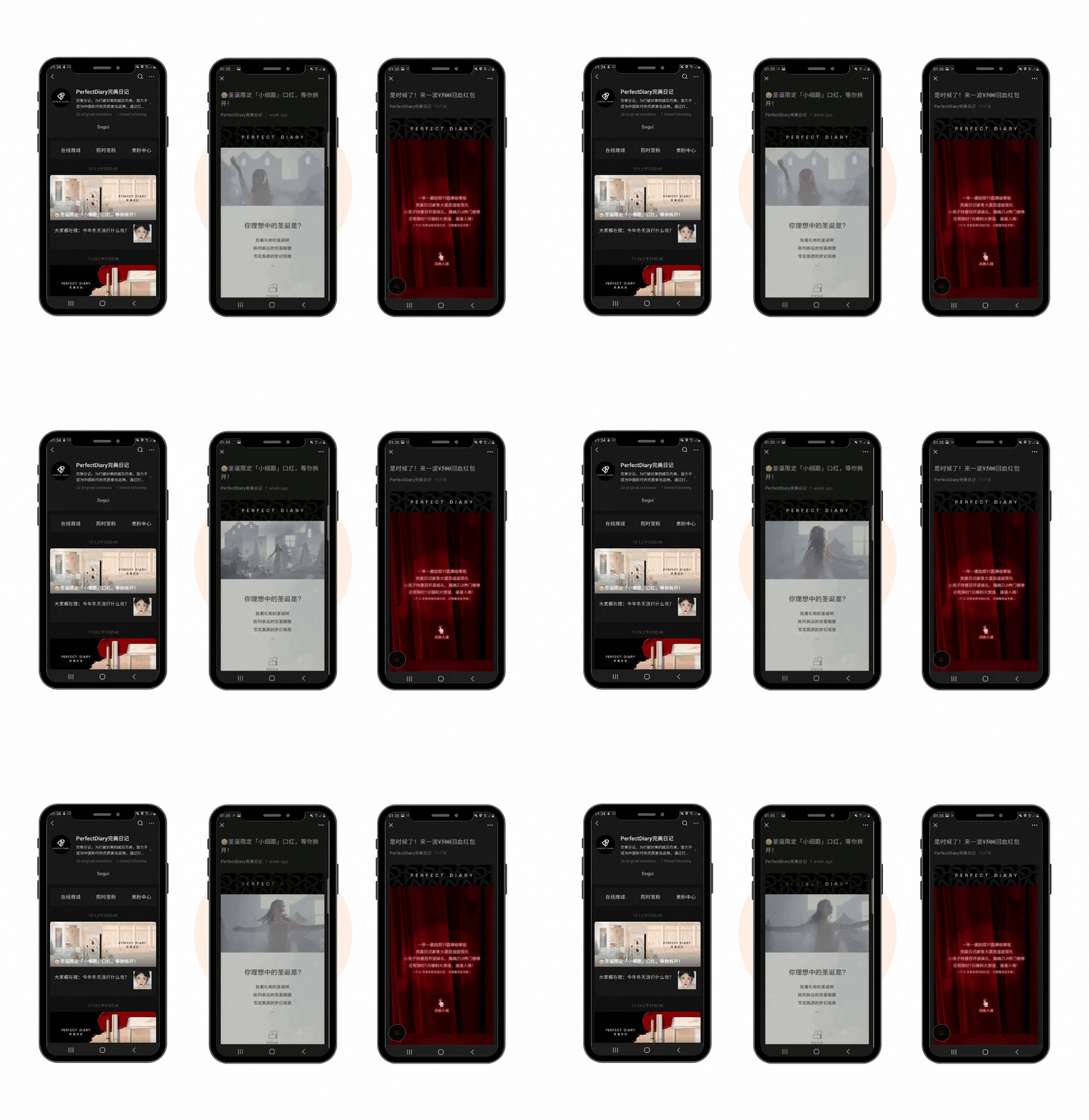
WeChat is the protagonist of Perfect Diary’s social media strategy. PD has used the app to nurture relationships with its audience through direct-to-consumer services.
In fact, not fully trusting other distributors like Taobao or JD, the brand decides to invest more money in the app. The result? More engagement, consumer data acquisition, and higher margins.
As you subscribe to Perfect Diary’s official account on WeChat, an article is automatically sent to you, which contains a little guide about features and promotions, then you’ll receive a link to its mini program and a gift.
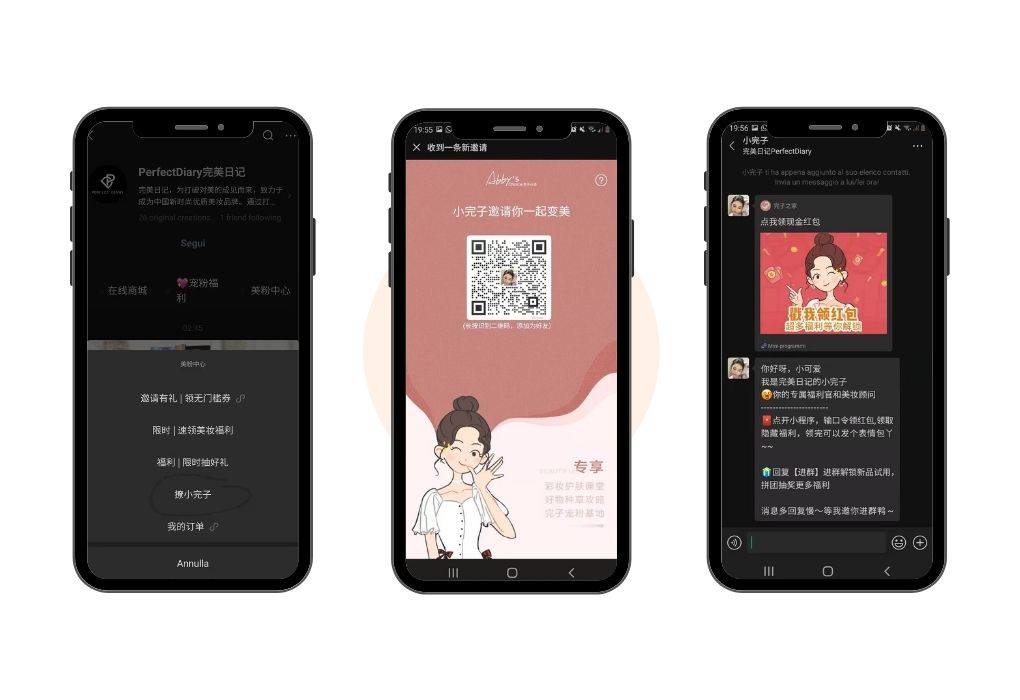
In the root menus, there are leads to promotions, cosmetic tips, online stores, coupons, and not only. So, at first glance, Perfect Diary’s WeChat account seems to be a standard one, however, you can find an original tool just in the bottom right root menu.
Among the four sub-menus, in fact, you can see the labeled “撩小完子” (“flirting with Xiaowanzi”) menu. At this point, you tap “撩小完子” and a QR code pops up, by scanning it you can add Xiaowanzi as a friend on WeChat.
4. Xiaowanzi: the avatar that manages Perfect Diary’s WeChat groups
Xiaowanzi is an avatar created to run Perfect Diary’s official account and chat groups. Also, a beautiful twenty years old woman, just like most of the Perfect Diary’s clients.
By visiting her Moments, we see that she runs a normal life and looks beautiful enough but not much. The consequence is that users feel better watching her posts than watching those of excessively photoshopped people.
Moreover, moments updates are ads, but also make-up tips, selfies, photo-touching tips; and occasionally, movies she watched. In conclusion, everything Xiaowanzi does has the aim of building herself as relatable as possible so that she can do a better job.
Xiaowanzi interacts with users and sends them information about products through private chats and WeChat groups. There are two types of groups that she managed: the “standard” group (but not at all) and the pop-up WeChat group.
A couple of times a day, Xiaowanzi posts a Mini Program link or announces a promotion in the “standard” group. By tapping the link, users can directly go to the item page, or to a live-streaming channel that advertises a certain cosmetic product.
Then, it is assumed that what Xiaowanzi does is not just merely promotion, she’s in charge of joining discussions and updating Moments to create engagement.
The pop-up WeChat group instead operates like a surprise event and here too, Xiaowanzi is the protagonist.
How does she behave?
- First of all, she sends an invitation to each customer via private message.
- Then, she announces in the group the exact time of the promotion (usually 3 hours prior). After the purchase, Xiaowanzi sends to customers the link of a live-streaming event, where a streamer sells Perfect Diary products.
- Finally, Xiaowanzi deletes the group.
The whole process is simple and rapid. It also is interesting to know that the pop-up group takes place at night and lasts just one hour. So, everything is scheduled according to customers’ routines.
What to take from the Perfect Diary’s case study
We have seen how a totally new brand has been able to adapt its strategy to the huge Chinese market. It’s clear that it won by building a creative strategy addressed to a very specific target: the Gen Z, highly educated young Chinese with a strong interest in new trends and good-looking design.
This case study shows us how China can offer great possibilities for success to big groups as well as to small dynamic companies.
Are you a cosmetic brand? Is your target Gen Z? China is waiting for you!
Collaborating with an agency specialized in the Chinese market is the best way to achieve your goal and increase your Return On Investment. As all companies are different, the marketing and advertising strategy must be tailored according to their needs and within their financial means.
Proud of the success of the companies we have helped over the years, we know exactly what a certain company needs.
Thus, if you have questions about selling, advertising, exporting, etc. your cosmetics in China, contact us directly, and we will reply to you within 24 hours.
1 comment